

On May 5, Coinbase cut 700 people. The same day, Brian Armstrong called it deliberate. Reuters has documented this pattern: it’s the third time in four years Coinbase has cut during a market dip. Armstrong told the New York Times the layoffs were also reacting to a crypto downturn. The language of transformation is consistent. The trigger is always the same.
PayPal's new CEO — three months in — announced a 20% cut on his first earnings call and named an AI transformation team. PayPal stock fell more than 8% that day. The market knew what Lores himself admitted: the company had underinvested in its technology infrastructure and lost ground to rivals. When the real problem surfaces alongside the AI framing, the framing doesn't hold. PayPal isn't an exception to the pattern — it's what the pattern looks like when the story doesn't land.
Here’s why the pattern keeps repeating: it works, on the only scoreboard anyone watches that day.
Coinbase rose ~4% on layoff day. Block surged 24% when it cut 40% in February. Aleksandar Tomic at Boston College names the mechanism plainly — companies reframe business problems as efficiency moves, the stock price goes up, and the next company takes it as authorization. This is happening amid 45,000+ tech layoffs in Q1 2026 alone, a 51% increase over the prior year. Howard Yu calls it a permission slip. One company cuts. Another treats it as instruction.
What the stock price doesn’t capture is what Gartner found when it surveyed 321 customer service leaders: only 20% of companies attributing their layoffs to AI actually cut because of AI. The rest had a business problem and gave it a better name. Forrester followed with its own survey of employers: 55% already regret the cuts they made.
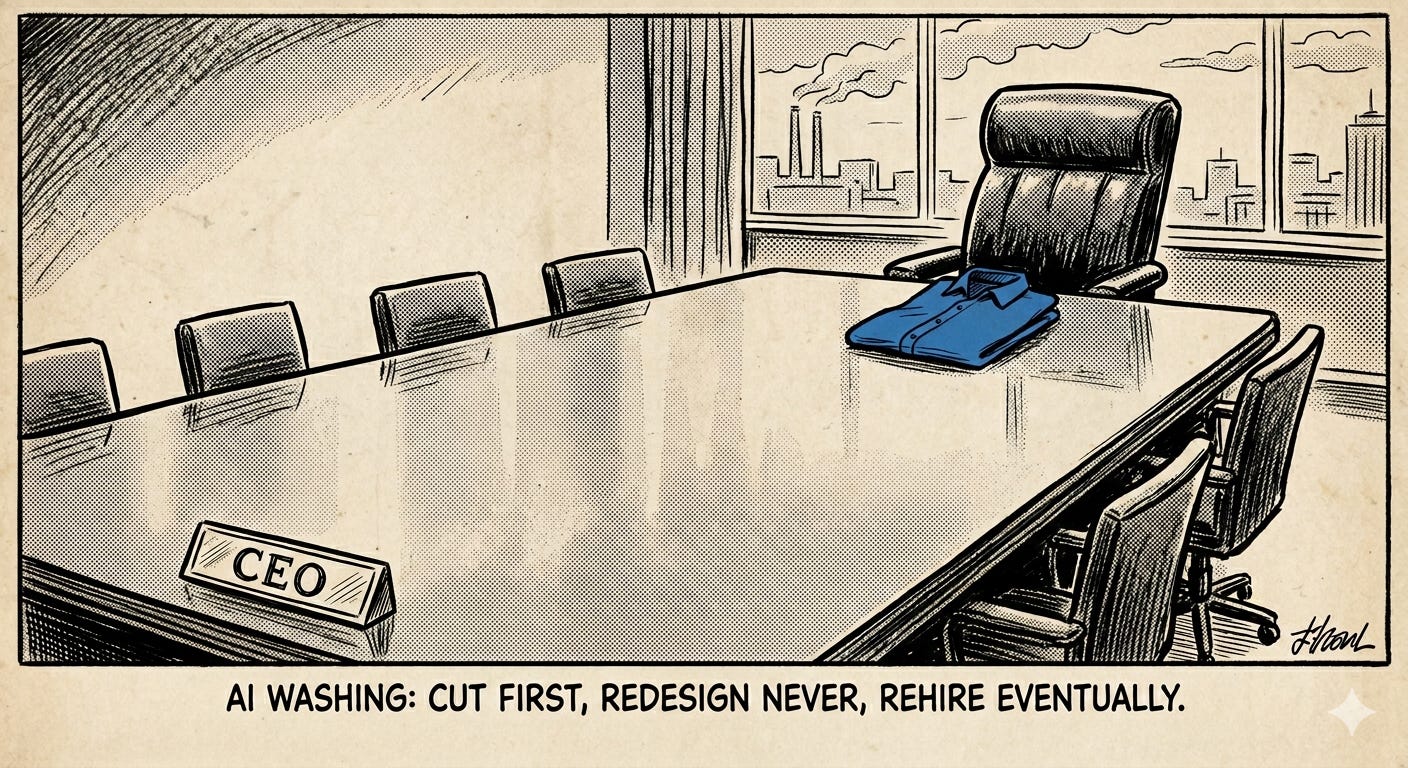
Cut first. Redesign never.
Mizuho Securities analyst Dan Dolev was more direct still: the crypto winter “may be the real reason behind most layoffs,” with AI the convenient excuse. The data and the analyst are saying the same thing. The narrative is the product.
This is AI washing: the same move greenwashing ran for a decade, now running on a faster cycle because the quarterly pressure is higher and the buzzword is newer.
Klarna is why that phrase matters.
The company cut roughly 700 customer-service roles, handed 75% of interactions to AI, watched quality collapse, and reversed course. CEO Sebastian Siemiatkowski said it plainly: “We focused too much on efficiency and cost. The result was lower quality, and that’s not sustainable.”
The reversal didn’t bring anyone back.
Seven hundred people lost their jobs for a decision that was unmade. Not transformation — displacement. The distinction is important, because one of them can be planned for and one of them can’t be undone.
Bobby Young had worked the floor at Circuit City for twenty years. He was shown the door at 8:15am. He knew which vendors would hold under pressure and which would ghost. He knew what would break first. Nobody had asked.
Sixteen months later, Circuit City filed Chapter 11.
Howard Yu calls this the blue-shirt test: did anyone go to the floor first? Did anyone sit with the people doing the work long enough to learn what would actually break? Circuit City failed it. So did Klarna. The difference between them is only time — Klarna found out in months instead of years, and still couldn’t make the people whole.
Stanford’s Digital Economy Lab — led by economist Erik Brynjolfsson — studied 51 cases of companies integrating AI into their workforce. The finding was consistent: “The difference was never the AI model. It was always the organization.” A separate MIT study of generative AI pilots found that 95% fail to produce measurable financial impact — not because the model wasn’t good enough, but because the workflows weren’t redesigned first. At scale, that means billions in AI investment that moved headcount without moving outcomes. Most companies stop at the first question — what can we cut? The Stanford question is what they could build instead.
That question requires going to the floor before making the decision. It requires sitting with the people doing the work long enough to understand what would break and what could be reimagined.
Ingka did. They redeployed 8,500 workers around AI rather than replacing them with it. The result was €1.3 billion in new revenue. They cut nothing first. They redesigned everything first. What was left to right-size, they right-sized. Klarna inverted that sequence. So did Coinbase. So will the next company that sees Coinbase’s stock move and treats it as a plan — and eventually, as Gartner forecasts, half of them will rehire for the same roles they eliminated.
Gartner puts a number on it: 50% of companies that cut for AI will rehire for the same functions by 2027.

In your next board meeting, ask this question:
“If we cut 15% next month, which workflows break first — and did anyone in this room sit with the people doing the work long enough to know?”
Sources: New York Times, Fortune, Reuters, Forbes, Bloomberg, Wall Street Journal, Mizuho Securities (Dan Dolev), Stanford Digital Economy Lab (Pereira, Graylin & Brynjolfsson — “The Enterprise AI Playbook,” April 2026), MIT NANDA Initiative (2025), One Inch Ahead (Howard Yu), Gartner, Forrester. Ingka/IKEA figures as reported by Reuters and Ingka Group Newsroom. PayPal stock movement as reported by Bloomberg and Wall Street Journal, May 5, 2026.
The Bosch Brothers is written by Bala and Krishna Bosch at Keryx Solutions, where they work on AI integration, software architecture, and product delivery. More at keryxsolutions.com