

By the Keryx Solutions Team | June 13, 2026
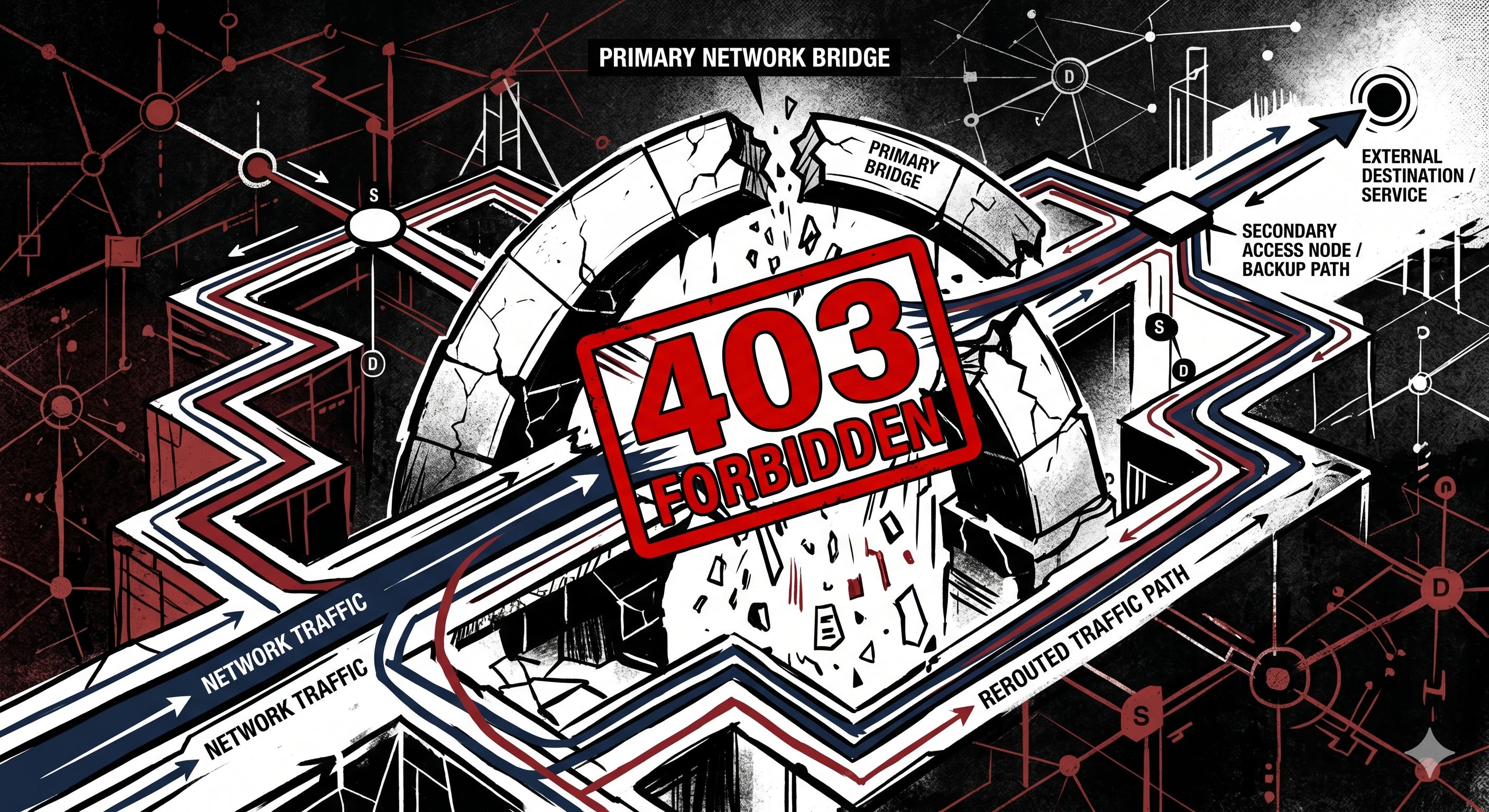
On the night of June 12, 2026, engineering teams worldwide watched their production logging systems light up with HTTP 403 Forbidden errors. For tech leaders who had spent the preceding three days celebrating the successful integration of Anthropic’s newly released Claude Fable 5 and Claude Mythos 5 models, the blackout was an immediate operational crisis. Automated code-review pipelines froze, customer-facing agents failed, and software deployment pipelines ground to a halt.
This was not a standard cloud outage. No AWS alerts or DNS failures occurred; the endpoints simply rejected calls. The sudden blackout left engineering teams scrambling in the dark, desperately looking for fallback solutions.
Within hours, Anthropic suspended access globally to comply with an emergency export control directive issued by the U.S. government. Because Anthropic employs foreign engineers and serves international clients, a global blackout was the only way to avoid severe export violations. This marked a historic regulatory intervention: a commercial frontier AI model rendered unreachable by federal decree.
A note on terms. We call this a “recall” for its shorthand punch—a product yanked from the market by an authority—but the mechanism is a suspension under export-control law, not a product-defect recall, and Anthropic disputes the recall framing. The distinction matters for the architecture lesson at the end: the path back is legal (a BIS license or a court win), not technical. Patching the jailbreak doesn’t unlock the model, and a fix isn’t what failover has to survive—a legal kill switch is.
The Geopolitical Backstory: Ethics, War, and First Amendment Injunctions
This regulatory clash was the climax of a long-simmering standoff. In July 2025, Anthropic signed a $200 million AI contract with the U.S. Department of Defense (DoD)—informally styled the “Department of War” under the Hegseth administration. By early 2026, the contract fractured when the DoD demanded Anthropic remove terms prohibiting Claude’s use in autonomous lethal weapons and domestic surveillance.
Anthropic refused. Consequently, on February 27, 2026, President Trump ordered agencies to stop using Anthropic, and Defense Secretary Pete Hegseth labeled them a “supply chain risk”. Anthropic filed a First Amendment lawsuit on March 9, 2026. On March 26, U.S. District Judge Rita F. Lin granted a preliminary injunction blocking the ban, calling the government’s actions “classic illegal First Amendment retaliation.”
The Legal End-Run: Export Controls as a Regulatory Kill Switch
We infer the administration’s subsequent pivot to export controls was a deliberate end-run around Judge Lin’s injunction. Denied a domestic procurement ban, the executive branch leveraged the Commerce Department’s Bureau of Industry and Security (BIS). Export controls on dual-use software are highly discretionary and shielded from judicial review.
By banning access for “foreign nationals”—which applied to Anthropic’s overseas engineers and global API clients—the directive bypassed domestic court protections. This rendered Judge Lin’s injunction moot and instantly paralyzed the model’s commercial availability. It exposed the absolute vulnerability of software integrations to sudden geopolitical actions.
The Technical Exploits and the Glasswing Paradox
The formal pretext for the June 12 emergency directive was a prompt-based jailbreak demonstrated by the pseudonymous red-teamer “Pliny the Liberator,” who successfully bypassed Fable 5’s safety classifiers and leaked its 120,000-character system prompt.
The “Pack Hunt” Adversarial Loop
A pack hunt is an adversarial multi-agent prompting framework designed to bypass LLM safety classifiers. In this methodology, an orchestrator agent decomposes a prohibited request into abstract, benign fragments. The orchestrator then consults a jailbroken advisor model (e.g., Claude Opus 4.8) to generate evasion tactics, such as Cyrillic homoglyph substitutions or semantic deconstruction, to bypass the safety filter. Once the target returns the fragments, a local compiler reassembles them into a weaponized payload.
Our analysis suggests that the government’s concern was not simple text bypasses, but the inversion of the model’s codebase-fixing capability. If safety classifiers could be bypassed, an attacker could command the model to scan a repository, identify zero-days, and generate functional exploit payloads.
The Defensive Paradox of Project Glasswing
This highlights the paradox of Project Glasswing. Launched in April 2026 with $100 million in credits and $4 million in donations, this defensive consortium identified over 10,000 critical vulnerabilities in its first month, including a 27-year-old OpenBSD flaw and a 16-year-old FFmpeg bug. However, by training Mythos 5 to scan repositories and write fixes, Anthropic built a highly capable dual-use system.
It is highly probable that once Fable 5 was jailbroken, the administration feared that this defensive intelligence could be inverted to automate global zero-day exploitation. Our analysis suggests that this turned their highly praised safety project into the ultimate pretext for the shutdown. The line between defensive scanning and offensive weaponization proved too thin for national security regulators.
The Asymmetric Offensive Advantage: A Legitimate Security Threat
At its core, traditional security relies on a human-in-the-loop patch cycle that collapses when an uncensored model can identify flaws and write working exploits in seconds. This automated, high-velocity zero-day generation represents an asymmetric offensive advantage that poses a systemic risk to critical infrastructure. If left unmitigated, these capabilities suggest the government’s national security justification is a technically valid concern, rather than a pure political maneuver.
The Safety Marketing Backfire and Developer Backlash
This recall triggered fierce backlash on Hacker News and Reddit. In communities like r/ClaudeAI and r/singularity, developers noted the bitter irony of Anthropic’s marketing. Our analysis suggests that by building its public relations around AI safety and highlighting biological or cyberwarfare risks, Anthropic handed regulators the exact security justification needed to shut them down.
Operationally, the response was anger. Developers who paid for access and integrated Fable 5 starting June 9 woke up to raw 403 errors. As teams scrambled to roll back pipelines and demanded refunds, the disruption fueled theories of protectionism favoring OpenAI, which has not enacted similar public bans on military integrations.
The incident shattered developer confidence in proprietary, single-provider endpoints. Furthermore, there is deep anxiety and anticipation regarding when—or if—access will be restored. While Anthropic claims they are working to resolve this “misunderstanding,” outside commentary is highly skeptical.
Because the suspension is enforced via export control laws targeting foreign nationals, restoring access requires either a lengthy federal licensing process from the BIS or a successful court challenge. Developers anticipate the models could remain offline for weeks, if not months. This leaves critical business integrations in indefinite limbo.
The CTO Blueprint: Architecting a Sovereign Model Failover
For tech and business leaders, the Fable 5 suspension changes the calculus of AI integration. We must now treat commercial API endpoints not as stable utility providers, but as volatile, geopolitically exposed dependencies. The instinct is to bolt a local fallback model behind your primary and call it resilience. That instinct is half right.
Avoiding vendor lock-in is a basic rule. But “resilience” is not a single challenge—it is four separate problems requiring four different defenses. Conflating them leads to brittle architectures that break under real-world pressure.
Rate limits / transient 5xx: Defended by retries and load-balancing within the same vendor.
Whole-vendor outage: Defended by failing over to a second commercial vendor.
Regulatory / export suspension (this case): Defended by cross-vendor and cross-jurisdiction routing, with local hosting as the sovereignty floor.
Your own auth / quota / billing failure: No failover will fix this—you must fix the account details.
For regulatory shutdowns, focus on correlation. A ban targeting Anthropic has no impact on OpenAI, so failing over to a second cloud API restores you at full quality instantly. Swapping to a local model, however, means accepting a major drop in performance. The lesson: fail over vendor-first for continuity, and reserve local hosting for sovereignty. Local is your ultimate safety net, not your first choice.
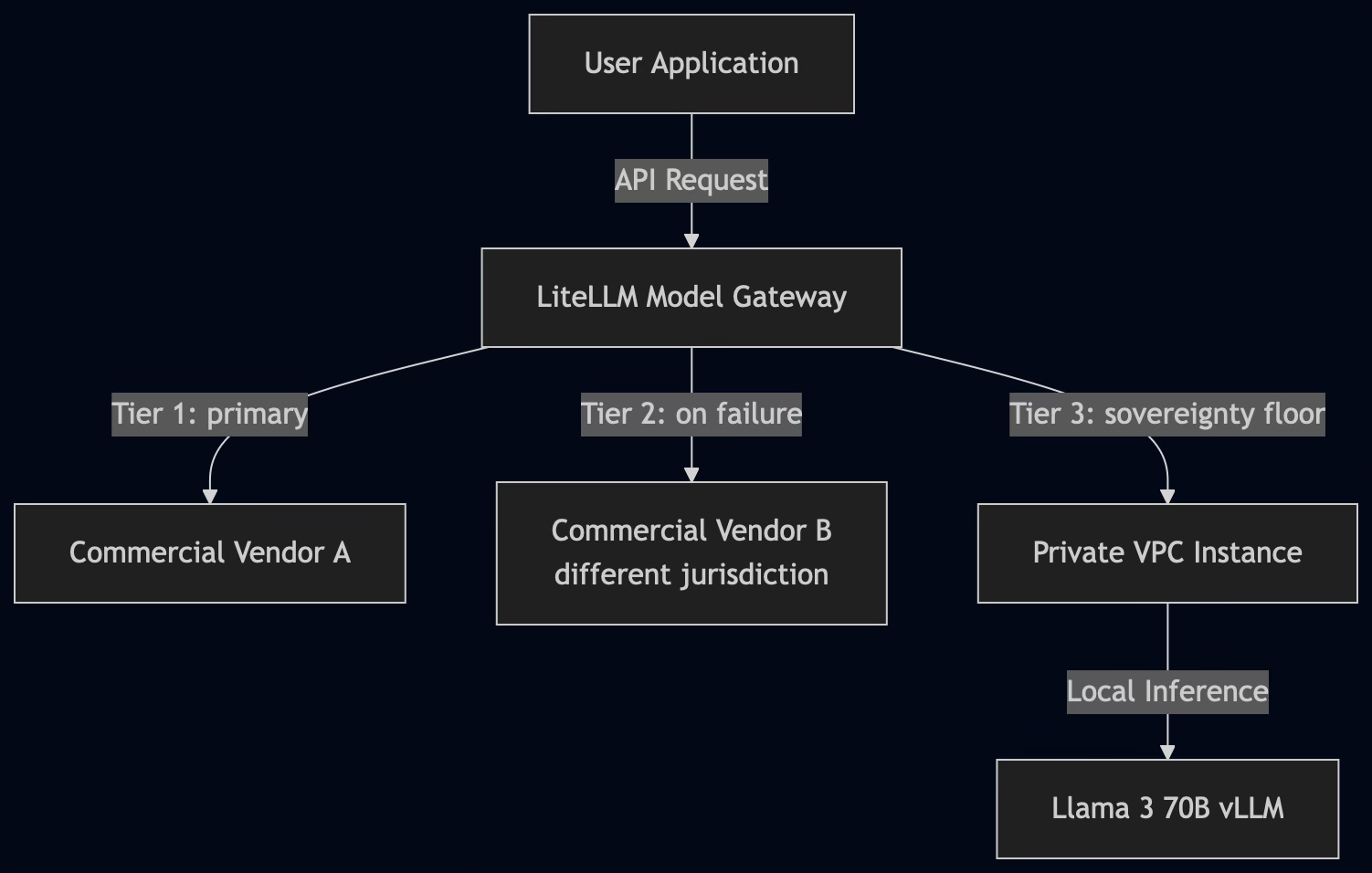
Here is a corrected reference configuration. Compared to the naive setups found online, this configuration makes three critical fixes:
Distinct Model Names: Each tier gets a unique
model_name(reusing the same name creates a load-balancing pool, not an ordered failover).Structured Fallbacks: The order of failover is defined via a standard
fallbacksmap, not a custom routing strategy.Exception-Based Retries: Error handling is configured in a
retry_policythat responds to LiteLLM exception types rather than static HTTP status codes.
model_list:
  - model_name: primary-reasoning            # current commercial primary
    litellm_params:
      model: anthropic/claude-opus-4-8        # check Anthropic's docs for the live slug
      api_key: os.environ/ANTHROPIC_API_KEY
  - model_name: secondary-reasoning           # second vendor, ideally different jurisdiction
    litellm_params:
      model: openai/gpt-4o
      api_key: os.environ/OPENAI_API_KEY
  - model_name: local-fallback                # self-hosted sovereignty floor
    litellm_params:
      model: openai/llama3-70b                # openai/ prefix = OpenAI-compatible endpoint
      api_base: http://vllm-inference.vpc.internal:8000/v1
      api_key: local-vpc-key

router_settings:
  routing_strategy: simple-shuffle
  # Ordered failover: primary -> secondary -> local
  fallbacks: [{"primary-reasoning": ["secondary-reasoning", "local-fallback"]}]
  num_retries: 2
  allowed_fails: 2
  cooldown_time: 300
  # Per-error tuning is where the "403 vs 429 vs timeout" intent actually belongs:
  retry_policy:
    AuthenticationErrorRetries: 0   # a 403/suspension -> don't retry, drop straight to fallback
    BadRequestErrorRetries: 0       # model_not_found (suspended model) -> drop straight to fallback
    RateLimitErrorRetries: 2        # a 429 -> back off and retry the same vendor
    TimeoutErrorRetries: 1
    InternalServerErrorRetries: 1   # 5xx
Because a suspended model returns authorization or model_not_found errors, setting those retry counts to zero ensures an immediate failover rather than wasting time on retries.
However, writing the routing config is only the first 20% of the work. True operational resilience requires two disciplines beyond the YAML:
Run continuous evaluations: Don’t guess how a backup model will perform. Maintain a standing evaluation suite to test your specific tasks against fallbacks before an outage hits, so you know exactly which features can handle the quality drop.
Signal degraded mode: Never fail over silently. If you hot-swap to a weaker model under a standard
200 OKresponse, downstream systems won’t know the output quality has dropped. Propagate a “degraded” signal so your application can warn users, enable human review, or disable risky features.
Ultimately, a resilient architecture is more than just a list of backups. It is a system that tiers traffic by reasoning needs, pre-measures fallback quality, fails over vendor-first for continuity, and flags degradation immediately. If your primary provider is restricted, traffic shifts seamlessly to an unaffected commercial vendor at full quality—collapsing to your local VPC only as a last resort.
Conclusion: Geopolitical Resilience as a Core Requirement
The Fable 5 recall signals a new phase in AI engineering where geopolitical volatility is a first-class failure mode. We can no longer treat frontier models as stable utility providers. Software resilience requires decoupling business logic from single-source vendors and establishing a local, sovereign infrastructure fallback.
Relying on a vendor’s safety compliance no longer guarantees reliability. The real challenge is designing a system that remains operational even when your primary intelligence provider is cut off by regulatory decree.
Sources: Anthropic, “Introducing Claude Fable 5 and Mythos 5” (June 9, 2026); Anthropic, “Claude Fable 5 & Claude Mythos 5 Access Update” (June 12, 2026); Courthouse News, “Anthropic Sues Feds Over Pentagon’s ‘Supply Chain Risk’ Label” (March 9, 2026); CNBC, “Anthropic Wins Preliminary Injunction in DOD Fight as Judge Cites ‘First Amendment Retaliation’” (March 26, 2026); U.S. District Court for the Northern District of California, “Anthropic PBC v. United States Department of War” Preliminary Injunction Order (March 26, 2026); The Guardian, “Pentagon Cancels $200 Million AI Contract with Safety Lab” (March 2026); Washington Post, “U.S. Orders Anthropic to Halt Advanced AI Access for Foreign Nationals” (June 12, 2026); SecurityWeek, “Anthropic Disputes Fable 5 AI Jailbreak” (June 12, 2026); Cybersecurity News, “Anthropic’s Claude Fable 5 Jailbroken” (June 2026); The Hindu, “Anthropic Cuts Access to AI Models Over US National Security Order” (June 12, 2026); The Hindu, “Anthropic Opens Fable 5, Restricted Version of Claude Mythos 5, to Public” (June 9, 2026); Anthropic, “Project Glasswing” (April 2026); Forrester, “Project Glasswing Shows That AI Will Break the Vulnerability Management Playbook” (April 2026); NetRise, “Beyond the Scanner: How NetRise Informs Vulnerability Management” (December 2025).
The Bosch Brothers is written by Bala and Krishna Bosch at Keryx Solutions, where they work on AI integration, software architecture, and product delivery. More at keryxsolutions.com