

You know exactly what you would automate first. You’ve known for months. The scheduling bottleneck. The quoting process. The three hours your office manager spends every afternoon on work that a competent intern could handle if you could afford one.
You haven’t moved. Not because you don’t understand the tools. You haven’t moved because nobody your size has moved first — and every operator you trust is doing the same math: wait for someone comparable to take the risk, then follow fast.
This is not an information problem. Information problems are solved by reading more. This is a permission problem — and permission problems are only solved when someone else acts first.
In 2024, that instinct was rational. AI agents broke things. They hallucinated in customer-facing workflows. You were right to wait.
The thing you were waiting for already happened. You were watching for a signal. Nobody sent one.

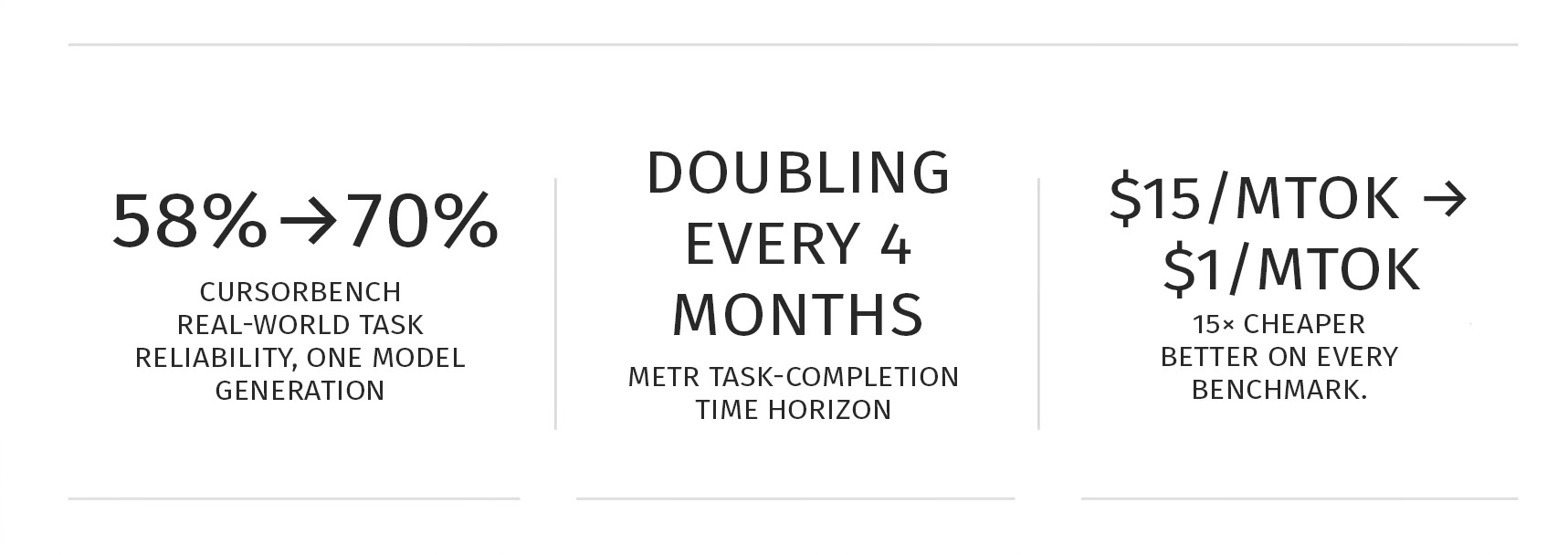
CursorBench measures real-world computer task completion — booking flights, filling forms, navigating spreadsheets without supervision. Opus 4.6 scored 58%. Opus 4.7 scored 70%. A separate measure tells a similar story: METR, an independent evaluator, found the length of tasks agents can complete without supervision is now doubling roughly every four months — up from every seven.
Price moved further. In March 2024, Claude 3 Opus cost $15 per million input tokens. Today, Claude Haiku 4.5 costs $1, and outscores Opus 3 on every benchmark Anthropic publishes. Fifteen times the capability per dollar in two years.
Smart Charge America — an EV charger installer with 50 to 200 employees — automated their quoting, scheduling, installation booking, and post-installation communication using Zapier, Airtable, QuickBooks, and a CRM. Their VP, David Laderberg, told Zapier: “Without Zapier, we would have needed well over 100 employees today just to do what we’re doing. We would have been out of business by now.” They saved 145 work days in year one. Each estimator now sends 15 more quotes per day.
That is one operator. The second wired the agent in directly.
Contractor Appointments, an 11–50 person construction lead-gen company in Minnesota, wired ChatGPT into their after-hours text scheduling — AI handling the conversation, no human in the loop. Their CTO Ben Leone now books 20 to 50 additional appointments a day from leads that used to die after 6pm. $300,000 in incremental annual revenue captured by an agent answering texts. “We compare Zapier to hiring a full-time developer,” Leone said. “We’ve avoided that cost entirely.”
Same tools you have access to. Companies your size. Both already moved.
Every quarter you wait, those work days compound into someone else’s margin. While your team is still scheduling manually, your competitor just hired a second estimator with the labor they got back.
The case study from a peer in your trade publication is not coming. The keynote from an operator your size at next year’s conference is not coming. The permission slip is not in the mail — it was never going to be.
The signal you are waiting for does not exist — because the people who moved didn’t wait for one.

In your next leadership meeting, ask this question: Who in this room is still waiting for someone their size to do this first — and what would it cost us if we waited until they did?
Sources: Anthropic Claude Opus 4.7 announcement, CursorBench results (anthropic.com/news/claude-opus-4-7); METR, “Measuring AI Ability to Complete Long Software Tasks,” arXiv:2503.14499, March 2025 (arxiv.org/abs/2503.14499); Anthropic pricing page, current model lineup (docs.anthropic.com/en/docs/about-claude/models); Anthropic pricing March 2024, via Wayback Machine archive of docs.anthropic.com; Zapier customer story, Smart Charge America (zapier.com/customer-stories/smart-charge-america); Zapier customer story, Contractor Appointments (zapier.com/customer-stories/contractor-appointments).
The Bosch Brothers is written by Bala and Krishna Bosch at Keryx Solutions, where they work on AI integration, software architecture, and product delivery. More at keryxsolutions.com