

Disclosure: Agent Ready, built by Keryx Solutions (founded by Bala Bosch), is one of our products. The argument here stands independently — but when we reference the infrastructure layer, we're drawing on work our team has done directly.
Your brand holds the top organic spot for your most important keyword. Your SEO team earned it over years — technical optimization, backlink campaigns, content calendars that never missed a week. And yet when a prospect asks an AI engine the question that keyword was built to answer, your brand does not appear. Not on page two. Not at all. A smaller consultancy you have never worried about gets named as the definitive source. You are not just invisible. You are something worse — but we will get to that.
A leading enterprise SaaS brand held #1 for “supply chain resilience.” When the same query went through a generative engine, the AI cited a mid-tier consultancy’s white paper instead — not because of better backlinks, but because the consultancy offered proprietary data, cited sources, and expert quotations. The SaaS brand was not outranked. It was consumed. Its years of content gave the AI something to learn from; the consultancy’s gave it something to cite.
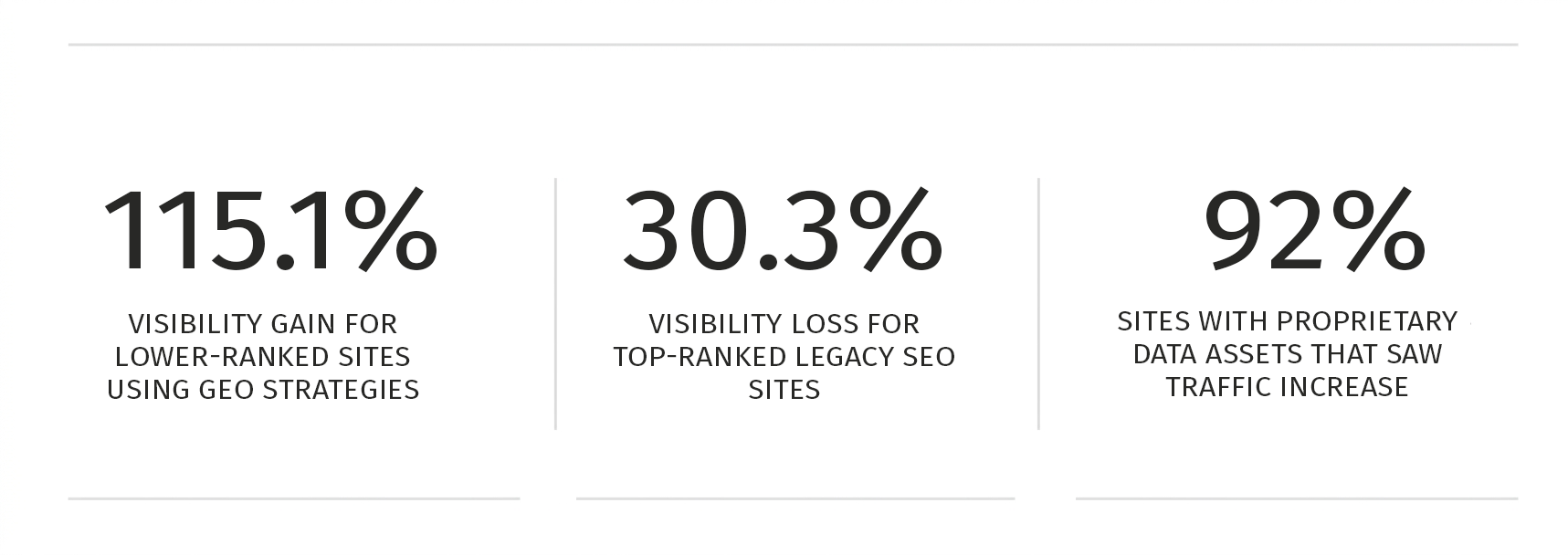
A peer-reviewed study accepted to KDD 2024 tested this directly. Websites that added citations, statistics, and expert quotations saw AI visibility increase by up to 40% — the study’s upper bound, measured in a controlled benchmark. Lower-ranked sites using these content-level strategies gained 115.1%. The sites that lost the most? The ones already ranked #1 — down 30.3%. The AI does not rank pages. It builds an answer and cites who helped it think. Your backlinks are still the entry requirement. They are no longer the deciding factor.
One wrinkle. The most-cited domain across all major AI platforms is Reddit. Peec AI’s analysis of 30 million sources confirms this. Whether community presence is a separate signal or just a proxy for the kind of brands that also publish proprietary research, nobody yet knows. Either way, the absence is disqualifying. Authority may now require both proprietary insight and visible participation in the conversations AI trusts.
This is the mechanism. The Link Economy rewarded who pointed at you. The Expertise Economy rewards what you can prove you know. The brands caught between the two — still optimizing for links, not yet producing citable expertise — become the raw material the AI learns from but does not credit. Rand Fishkin’s analysis of the zero-click era sharpens the point: 92% of sites offering proprietary data assets — original surveys, benchmarks, indexed datasets — saw traffic increase. Proprietary data was the strongest predictor. Not better keywords. Not more backlinks.
The assets that earn the citation look like this: an annual state-of-industry survey with 500+ respondents. A benchmark tracking a metric no one else tracks. A proprietary index that turns subjective judgment into a repeatable score. Each gives the AI something it cannot synthesize from existing content. A data point that exists nowhere else. Attributed to you.
But even proprietary data has to be findable. There is a second layer — infrastructure, not content. If an AI agent cannot reach your site, parse what is there, and extract the asset, the content layer does not matter. Cloudflare analyzed the top 200,000 domains on the internet: 78% have a robots.txt file, but most are written for traditional search crawlers, not AI agents. Only 4% have declared AI usage preferences via Content Signals. Only 3.9% serve Markdown to agents who request it — which can reduce token consumption by up to 80%. Fewer than 15 of 200,000 sites use MCP Server Cards or API Catalogs.
Bala Bosch, who runs agent-readiness audits through our Keryx work, has found that the gap looks different depending on what kind of site you run. A WordPress content site typically scores around 30% out of the box (most of that from the sitemap WordPress includes by default) — and can be 98% automatically configured for agent access from there. Sites with APIs are categorically harder. Most of the internet is the easy case and does not know it. What stops site owners is not difficulty but awareness. The universal failures are always the same: no llms.txt file, no link headers, no Markdown versions of page content. One site owner, seeing the full checklist of what agents need, said: “I don’t know what most of these things are.”
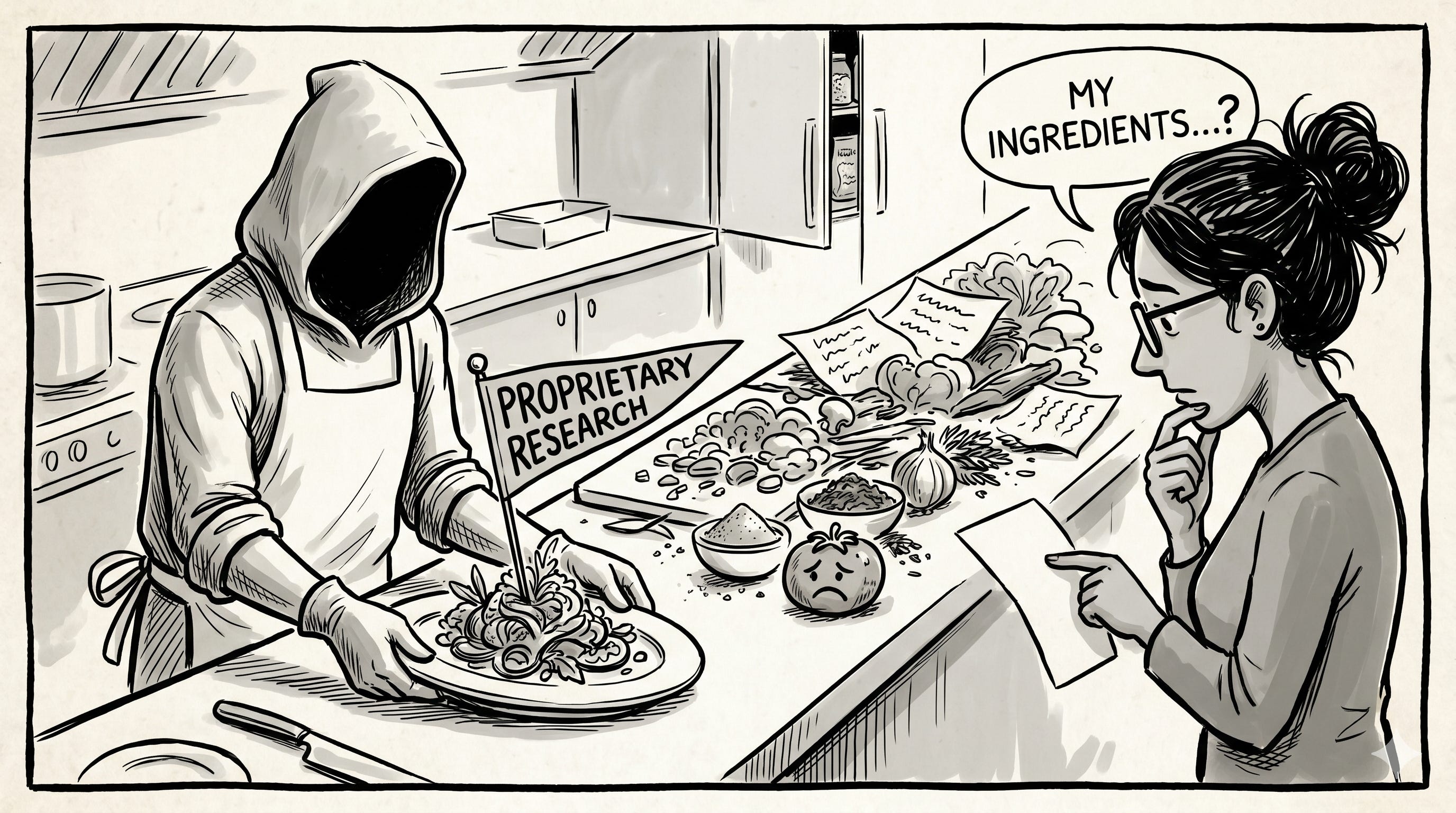
The brands doing the content work — the proprietary surveys, the benchmarks — are mostly failing on the infrastructure side. The AI cannot cite what it cannot reach.
The brands that adapted are the ones the AI names — on both layers. The ones that did not are not erased — they are just never deemed important enough to cite. They became the substrate. Training data. The input that makes the answer possible, but that the answer does not mention.
The rules changed without telling you.

At your next leadership meeting, ask this question:
“When we audit our top three competitors, which one is the AI naming as the ‘definitive’ source for our category — and what proprietary data are they providing that we aren’t?”
Then ask how your site scores on agent readiness compared to theirs.
Sources: Aggarwal et al., “GEO: Generative Engine Optimization,” KDD 2024; Fishkin, “5 Strategic Features that Predict Survival in the Zero-Click Era,” SparkToro, April 2026; Peec AI, “Top Domains Cited by AI Search,” March 2026; Cloudflare, “Agent Readiness on the Internet,” April 2026. To check your own site's agent readiness, visit isitagentready.com — a free scan from Cloudflare. For WordPress remediation, see Agent Ready (by Keryx Solutions, one of our products).
The Bosch Brothers is written by Bala and Krishna Bosch at Keryx Solutions, where they work on AI integration, software architecture, and product delivery. More at keryxsolutions.com