

Mo Gawdat is not a man who traffics in comfortable predictions. Google X’s former chief business officer — thirty years in technology, architect of some of the most ambitious moonshots in the industry’s history — has been sounding the alarm for nearly five years: AI will eliminate millions of jobs, and the timeline is shorter than anyone is comfortable admitting. When he published Scary Smart in 2021, his thought experiment placed the reckoning around 2055.
He no longer believes that.
The timeline has compressed by almost three decades in his own estimation, the disruption now arriving, in his telling, around 2027. Twelve to fifteen years of economic upheaval. A cascade, not a transition. New graduate hiring has already fallen sharply — a drop he puts at between 23 and 30 percent — not because the economy softened, but because AI now does what junior employees were brought in to do. Entry-level work goes first, he argues, not because it is least valuable but because it is most legible to a machine. And what follows is not gradual.
His argument deserves its gravity. If AI absorbs 30 percent or more of jobs, the consumption base that sustains capitalism begins to hollow. The leaders sitting with dread in their boardrooms, wondering what this means for the people whose names they know — they are not being irrational. They are paying attention to a serious argument made by a serious person, one who has watched his own predictions accelerate faster than he expected. One company, however, had already decided what to do about it.
In 2021 — the same year Gawdat first put his warning into print, when his own timeline still pointed toward 2055 — IKEA’s parent company Ingka made a quiet decision. Its AI system Billie had begun absorbing customer enquiries at scale. Rather than letting that volume displacement run its natural course, Ingka redirected approximately 8,500 call-centre employees into roles built around remote selling, relationship-building, and the kind of judgment-intensive work a system cannot replicate. No announcement. No manifesto. Just a choice, made deliberately, before the pressure made it unavoidable — in the same year the warning was first written, before most leaders had thought to be afraid.
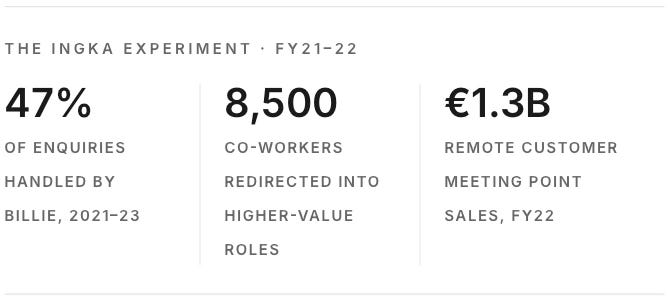
By the end of FY22, Ingka’s remote customer meeting points had reached €1.3 billion in revenue — a channel built entirely on human presence, human judgment, and human warmth. Reuters reported one product in the mix: customers in the UK could pay £25 for a 45-to-60-minute interior-design consultation by video, with a tailored product list. The people who used to answer predictable questions were now answering harder, more valuable ones. Customers were paying for the difference. The bottleneck, it turned out, was never the people. It was the work they had been given to do.
Gawdat’s darkest scenario assumes leaders will respond to displacement the way capitalism has always responded to new efficiency — extract cost, concentrate gain, move on. He is not wrong that many will. BCG’s 2025 global study of C-suite executives found that only 5 percent of companies have captured substantial financial gains from AI, and that group posts three-year shareholder returns roughly four times higher than those that haven’t. The separator, BCG found, was not the sophistication of the technology. It was whether leaders had deliberately redesigned how their people worked alongside it.
The World Economic Forum is unambiguous about the condition: AI will create more jobs than it displaces — but only if companies invest deliberately in people and redesign work rather than automating what already exists and calling it progress.
This is where Gawdat’s argument and the BCG evidence diverge. His case is about what AI makes inevitable for machines. The more urgent question — the one that still has an answer varying by company, by leader, by the quality of a single decision made before the pressure arrives — is what AI makes possible for the people already inside your organisation. Specifically, the ones about to be freed from work that was always beneath what they were capable of.

At your next meeting, add one question to the agenda: if this frees our people from X, what higher-value work could they do instead — and would a customer pay for it?
Ingka answered that question in 2021. Before the debate had a name. Before the dread had settled into boardrooms. Before Gawdat had compressed his own timeline from 2055 to 2027. The solution existed before most leaders had articulated the fear — which means this was never about waiting for certainty. It was always about what you decided to do before it arrived.
The people you are worried about losing are not a liability to be managed down. They can be the ones who build what comes next — if you design for it before the pressure makes the decision for you. That conversation most leaders keep postponing, the one about what their people become when the routine work is gone, is the one that unlocks everything else. It will not stay open indefinitely.
Sources: Ingka Group Newsroom · Reuters · BCG 2025 · World Economic Forum · Mo Gawdat, Scary Smart (2021) · Diary of a CEO
The Bosch Brothers is written by Bala and Krishna Bosch at Keryx Solutions, where they work on AI integration, software architecture, and product delivery. More at keryxsolutions.com